RESEARCH
Research Interests
My research focuses on the formation and evolution of low-mass galaxies using cosmological simulations. I am especially interested in understanding how internal processes, such as stellar feedback, and external processes, such as tidal interactions and environment, shape the structure, dynamics, star formation histories, and dark matter distributions of galaxies. A central theme of my work is the use of galaxy scaling relations to connect observable properties to the physical mechanisms that drive galaxy evolution. I also explore how machine learning can help identify the dominant physical drivers of galaxy evolution across diverse environments.
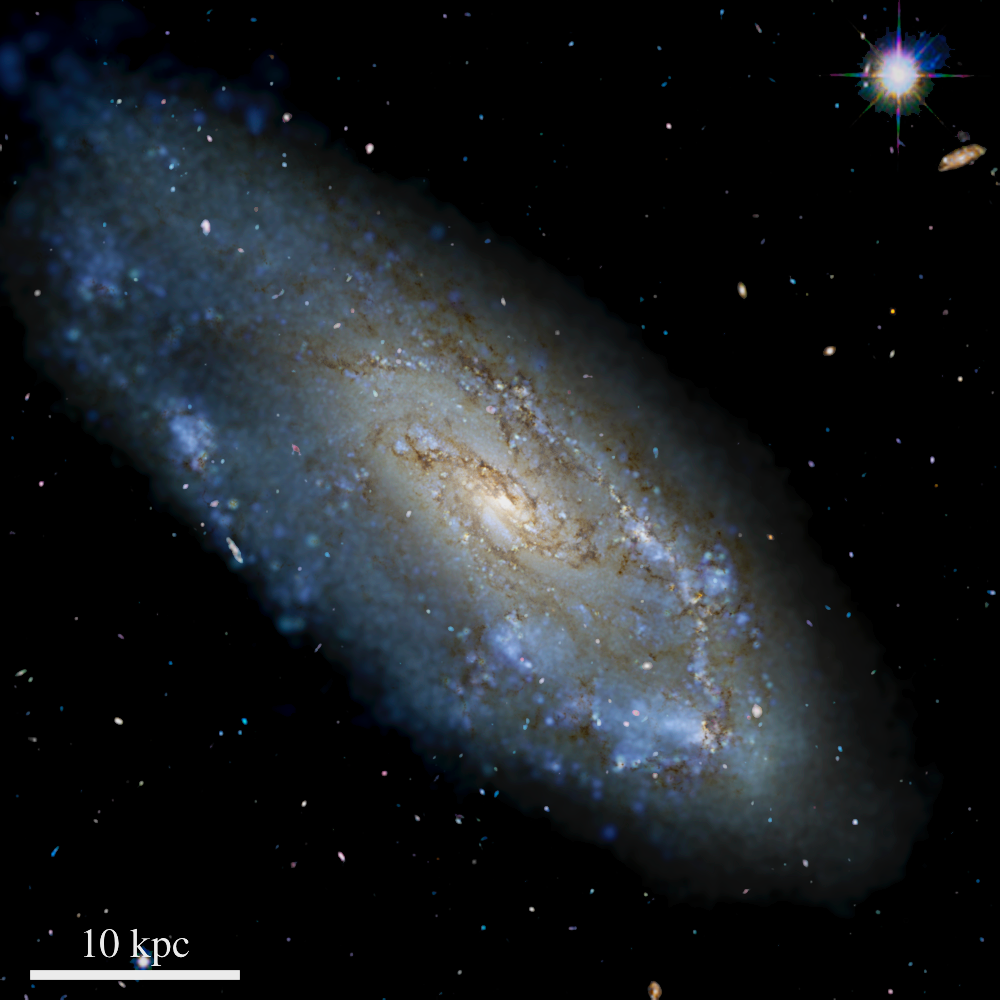
WildFIRE: A new generation of low-mass galaxy simulations
I am currently leading the development of WildFIRE, a new suite of roughly 300 high-resolution cosmological zoom-in simulations of low-mass galaxies spanning halo masses of about 10^8.5 to 10^11.5 solar masses. This mass range covers systems from the faintest galaxies to Large Magellanic Cloud-like galaxies, making WildFIRE a powerful dataset for studying how galaxies form at the low-mass frontier. What makes this project especially exciting is that WildFIRE is designed to sample a wide range of formation histories and environments, allowing us to study how internal processes, environmental effects, and dark matter physics shape the observable properties of low-mass galaxies. These simulations will provide theoretical predictions for upcoming surveys such as Rubin and Roman, which are expected to discover large numbers of faint galaxies in the coming years.

Nature vs. Nurture: A useful framework
A major theme of my research is understanding the relative roles of “nature” and “nurture” in shaping galaxies. In this framework, nature refers to the internal physical processes that govern a galaxy’s evolution, including stellar feedback, star formation, dark matter structure, and the redistribution of stars and gas. Nurture refers to the external influences imposed by a galaxy’s environment, including tidal interactions, satellite quenching, ram pressure, and the broader cosmological web.
Low-mass galaxies are ideal laboratories for studying this interplay. Their shallow gravitational potentials make them highly sensitive to both internal feedback and environmental processing. This means that small galaxies preserve clues about the physics that shaped them, from the effects of supernova-driven outflows in their centers to the influence of nearby massive galaxies on their star formation histories and structure.
Nature: Internal processes and the structure of galaxies
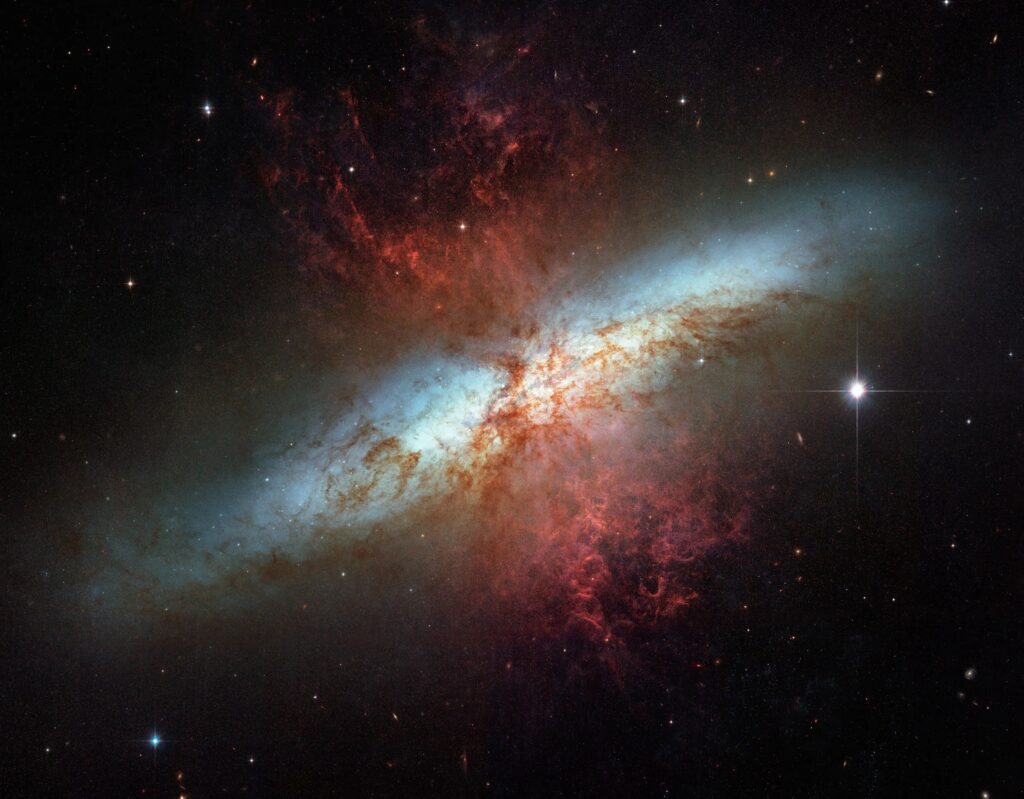
My past and recent work has explored how internal processes shape the observable structure of low-mass galaxies. One key focus has been the role of stellar feedback in redistributing stars, gas, and dark matter within galaxies. Because low-mass galaxies are especially sensitive to feedback-driven outflows, their stellar populations and dark matter distributions provide powerful tests of galaxy formation theory.
In Mercado et al. (2021), I discovered a new scaling relation for low-mass galaxies: the Gradient-Strength-Galaxy-Age relation. This relation connects the strength of a galaxy’s stellar metallicity gradient to the median age of its stars. In this work, I showed that older, metal-poor stars are gradually pushed outward over time by feedback-driven stellar migration, naturally producing negative metallicity gradients. This prediction has since been tested with observations of Local Group dwarf galaxies, including work using Hubble Space Telescope data to measure individual stellar metallicities in nearby systems.
In Mercado et al. (2024) I also studied how internal feedback affects galaxy dynamics through the Radial Acceleration Relation, a scaling relation that connects the total gravitational acceleration in a galaxy to the acceleration expected from its baryons alone. In simulated low-mass galaxies, I found that feedback-driven changes to the inner dark matter distribution can produce distinctive “hook” features in the relation. These features provide a natural explanation for deviations seen in both simulations and observations, while strengthening the case that low-mass galaxies can be used to test the connection between baryonic physics and dark matter structure.
Nurture: Environmental effects and galaxy evolution
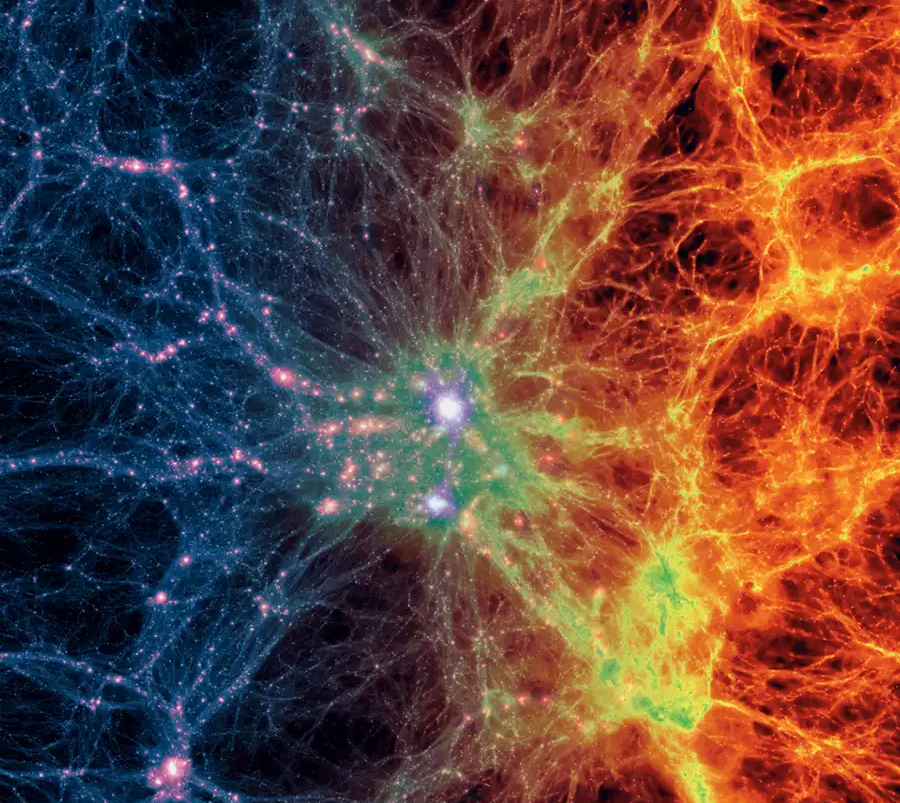
While internal processes play a central role in shaping galaxies, environment can dramatically alter the evolution of low-mass systems. Satellite galaxies and galaxies in dense environments can experience tidal stripping, ram-pressure effects, and suppressed star formation. These processes can change their sizes, dark matter distributions, star formation histories, and long-term evolutionary pathways.
In Mercado et al. (2025), I used the FIREbox cosmological volume to study how environment affects the size–mass relation of low-mass galaxies. I found that galaxies in more perturbed environments tend to be more radially extended at fixed stellar mass than their more isolated counterparts. This suggests that environmental interactions can alter the structure of low-mass galaxies in ways that are visible in their stellar distributions. I am now extending this work with Brian Giraud Calderon in a follow-up study on how environment influences galaxy formation timescales, using star formation histories to ask whether low-mass galaxies in denser environments assemble their stellar mass earlier than galaxies in more isolated regions (Mercado & Giraud Calderon et al. 2026). Together, these projects reframe environment not as a secondary effect, but as a major driver of galactic structure and evolution.
More recently, in Mercado et al. (2026a), I compared satellite galaxy quenched fractions across multiple simulations, including FIRE zoom-ins, FIREbox, and TNG50, and against observations from the SAGA and ELVES surveys. This work examines how the probability that a satellite galaxy has stopped forming stars depends on stellar mass and distance from its host. While simulations broadly reproduce the observed trend that lower-mass satellites are more likely to be quenched, the radial trends show significant variation that appears to be driven by differences in satellite distributions rather than the broader environment of the host. I am now building on this result in a follow-up study that investigates how host properties influence satellite quenched fractions, with the goal of identifying which aspects of the host galaxy and halo most strongly shape satellite evolution (Mercado et al. 2026b).
Connecting simulations, observations, and next-gen surveys
Across these projects, my goal is to build a theoretical framework that connects the observable properties of galaxies to the physical processes that shaped them. Galaxy scaling relations provide a powerful way to do this because they allow us to compare simulations and observations directly. By studying how galaxies populate relations involving size, stellar mass, metallicity, acceleration, morphology, and quenched fraction, we can identify the signatures of feedback, environment, and dark matter physics.
Looking ahead, my research will use WildFIRE and other simulation datasets to make predictions for the next generation of observations from Rubin, Roman, JWST, and future extremely large telescopes. These surveys will reveal low-mass galaxies across a wider range of environments and cosmic times than ever before. My work aims to ensure that we have the theoretical tools needed to interpret this new data and to use low-mass galaxies as laboratories for understanding galaxy formation, dark matter, and the growth of structure in the universe.
List of publications
Lead Author/Major Contributor
19. The quenched fraction of satellites around simulated Milky Way-mass galaxies F. J. Mercado et al. (2026)
18. Effects of galactic environment on size and dark matter content in low-mass galaxies F. J. Mercado et al. (2025)
17. Hooks & Bends in the radial acceleration relation: discriminatory tests for dark matter and MOND F. J. Mercado er al. (2024)
16. Comparing implementations of self interacting dark mater in the GIZMO and AREPO codes H. Meskhidse, F. J. Mercado et al. (2022)
15. Amplified J-factors in the Galactic Centre for velocity-dependent dark matter annihilation in FIRE simulations D. McKeown, J. S. Bullock, F. J. Mercado et al. (2022)
14. A relationship between stellar metallicity gradients and galaxy age in dwarf galaxies F. J. Mercado et al. (2021)
Contributing Co-author
13. From protogalaxy through thick and thin: Why did the Milky Way evolve in three kinematic phases? Myrtaj et al. (2026)
12. Beyond Cloud-9: The case for discovering more HI-rich failed halos J. Moreno et al. (2026b)
11. Confronting the Diversity Problem: The Limits of Galaxy Rotation Curves as a Tool to Understand Dark Matter Profiles I. Sands et al. (2026)
10. The Shape of FIREbox Galaxies and a Potential Tension with Low-mass Disks C. Klein et al. (2026)
9. Igniting Galaxy Formation in the Postreionization Universe J. Moreno et al. (2026a)
8. How Invisible Stellar Halos Bias Our Understanding of Ultrafaint Galaxies C. Wheeler et al. (2025)
7. Disks no more: the morphology of low-mass simulated galaxies in FIREbox J. Benavides et al. (2025)
6. Pickles on FIRE: The 3D Shape Evolution of Simulated Milky Way-Mass Galaxies L. Xia et al. (2025)
5. Stellar Metallicities and Gradients in the Faint M31 Satellites Andromeda XVI and Andromeda XXVIII S. Fu et al. (2024)
4. Size-mass relations for simulated low-mass galaxies: mock imaging versus intrinsic properties C. Klein et al. (2024)
3. Stellar Metallicities and Gradients in the Isolated, Quenched Low-mass Galaxy Tucana S. Fu et al. (2024)
2. Galaxies lacking dark matter produced by close encounters in a cosmological simulation J. Moreno et al. (2022)
1. The time-scales probed by star formation rate indicators for realistic, bursty star formation histories from the FIRE simulations J. A. Flores Velásquez